Build vs Buy Software for Small Business: The €500-5000 Sweet Spot Guide

Most small businesses pay €200/month forever for SaaS that doesn't quite fit. Here's the truth from someone who builds micro-SaaS AND tells 40% of clients when NOT to build.
After helping 200+ small businesses navigate the build vs buy software decision, I've learned something counterintuitive: the make or buy decision isn't about technology—it's about economics and timing. Most businesses get trapped in subscription quicksand, while others waste money building what already exists perfectly.
Key takeaways: • The €500-5000 custom software sweet spot beats SaaS after 12-24 months • Total cost of ownership includes hidden integration and training costs • Vendor lock-in can triple your software costs overnight • 80% of businesses should buy; 20% should build • The 3x rule: build only when SaaS costs 3x more annually than custom
Understanding Total Cost of Ownership (TCO)
Total cost of ownership goes far beyond sticker price. That €50/month SaaS becomes €200/month after integrations, training, and feature add-ons.
For SaaS: monthly fees × 36 months + setup + integrations + training + migration costs. A typical €100/month tool costs €5,400 over three years—not €3,600.
For custom software vs off-the-shelf, factor development (€2,000-15,000), hosting (€20-100/month), maintenance (10-20% annually), and opportunity cost of delayed launch.
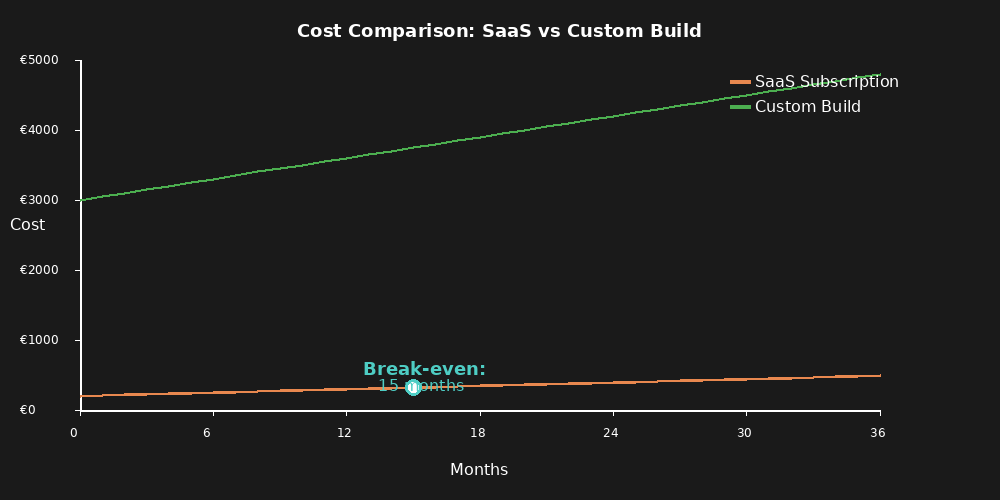
The break-even point? Usually 12-24 months for simple tools, 24-36 months for complex systems. Real example: client paid €180/month for project management SaaS. Custom solution cost €4,200, saving €1,960 yearly after month 24.
The SaaS Subscription Cost Trap
SaaS subscription costs compound through subscription creep. Start with a basic plan, add users, upgrade features, integrate tools. That €25/month becomes €200/month within 18 months.
Per-user pricing kills growing teams. Slack goes from €6/user to €12.50. With 15 employees, that's €1,125 extra annually per pricing jump.
Feature gating forces upgrades. Need API access? €50 more. Custom fields? Another tier. Export data? Premium only. SaaS fatigue hits when you're paying for features you don't use across multiple tools.
Smart businesses audit subscriptions quarterly. Cancel unused features, negotiate annual discounts, or calculate the build-vs-buy math when renewal hits.
Hidden Costs of Off-the-Shelf Software
Hidden costs multiply fast. Integration runs €500-5,000 per connection. Staff training takes 2-8 hours per person. Data migration eats weeks.
Compliance add-ons cost extra. GDPR module? €30/month. Advanced security? €50/month. Audit logs? Premium tier only. API rate limits force plan upgrades. Support tiers gate response times behind 20-50% price bumps.
Migration costs hit twice: moving in costs time and money, moving out costs more. Export limitations trap data in proprietary formats.
Real calculation: €100/month SaaS + €2,000 setup + €500/quarter integrations + €1,200 annual training = €5,900 first year, not €1,200.
When Custom Software Makes Sense
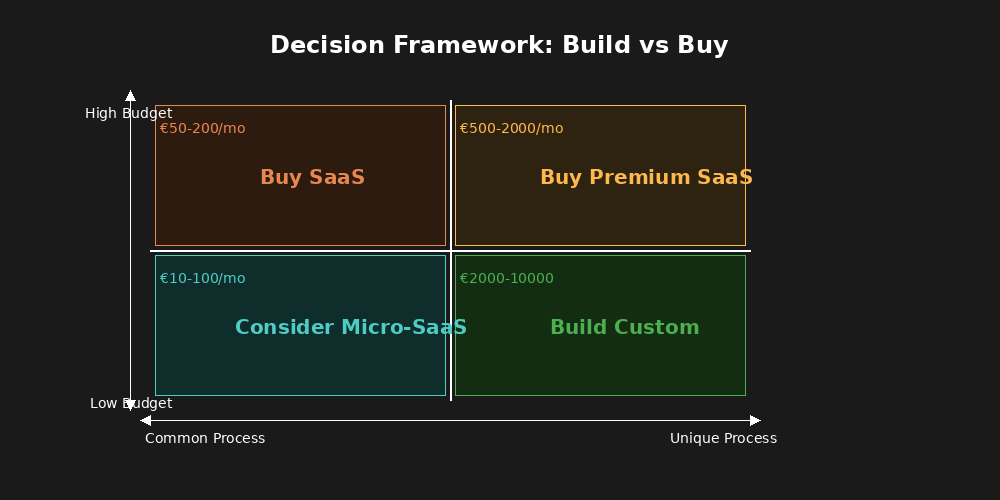
Custom software ROI shines when your processes are unique. If you're doing exactly what everyone else does, buy software. If your workflow gives competitive advantage, build it.
The 80/20 rule applies: if off-the-shelf covers 80% of needs, buy it. If you need the other 20% for core business functions, build custom.
Build when: • SaaS costs exceed 3x custom development annually • Your process differs significantly from industry standard • Integration costs exceed development costs • Data security requires on-premise hosting • Vendor lock-in poses business risk
Factor maintenance at 15-20% of development cost annually. And be honest about whether your "unique process" is actually unique or just undocumented.
Vendor Lock-in Risks and Escape Costs
Vendor lock-in transforms helpful software into expensive hostages. Prices increase 10-30% annually because switching costs exceed staying costs.
Data portability myths: "export data anytime" doesn't mean usable formats. CSV exports lose relationships, formatting, and automations. Rebuilding workflows costs thousands.
Exit planning before buying: test data export, document workflows, negotiate price protection clauses, maintain alternative vendor relationships.
Real story: client's CRM doubled pricing overnight. Migration quote: €25,000. They paid the increase for three years before switching—€18,000 wasted.
Micro-SaaS: The Middle Ground Nobody Talks About
Micro-SaaS fills the gap between bloated enterprise tools and basic solutions. The €500-5,000 sweet spot delivers custom functionality without enterprise complexity.
Think single-purpose tools: custom calculators, workflow automators, simple dashboards, specialized integrations. Built in days or weeks, not months.
Real examples: • €800 custom inventory tracker vs €200/month Fishbowl • €2,500 client portal vs €150/month generic solution • €1,200 automated reporting dashboard vs €300/month analytics suite
Advantages: faster development, lower maintenance, exact feature fit, predictable costs, zero vendor dependency. Development timeline: 1-8 weeks. Maintenance: €50-200/month.
When to Stop Subscribing and Start Building
The buy vs build framework starts with honest numbers. Track actual SaaS spending across all tools, including hidden costs and user expansion.
Decision framework: 1. Calculate true annual SaaS cost (fees + setup + training + integrations) 2. Estimate custom development cost + 20% annual maintenance 3. Apply the 3x rule: build only if SaaS costs 3x more annually 4. Factor team readiness and timeline urgency
The 3x multiplier protects against development optimism—custom software always costs more than estimated. Without technical leadership, development budget, or 2-6 month timeline flexibility, buy SaaS despite higher long-term costs.
ROI Analysis: Custom vs SaaS
ROI calculation requires honest accounting over 3-year periods, not monthly-vs-upfront comparisons.
SaaS: (Monthly fee × 36) + setup + integrations + training + price increases + switching costs
Custom: Development + (hosting + maintenance × 36 months) + opportunity cost
Real case study: • SaaS: €150/month × 36 = €5,400 + €1,200 setup/training = €6,600 • Custom: €4,000 development + €1,800 hosting/maintenance = €5,800 • Savings: €800 over three years, plus price protection
| Timeline | SaaS Total | Custom Total | Difference |
|---|---|---|---|
| Year 1 | €3,000 | €4,600 | -€1,600 |
| Year 2 | €4,800 | €5,200 | -€400 |
| Year 3 | €6,600 | €5,800 | +€800 |
Factor intangible benefits: exact feature fit, data ownership, no vendor dependency, unlimited users.
Common Mistakes Small Businesses Make
Biggest mistake: building commodity software. Quickbooks, Mailchimp, Shopify—these cost less and work better than custom alternatives. Don't build accounting, basic CRM, email marketing, standard e-commerce, payroll, or document storage.
Second mistake: buying SaaS for highly unique workflows. Generic project management tools don't fit specialized manufacturing processes.
The syndrome works both ways. Some businesses build everything; others refuse to build anything. Both cost more than the strategic make or buy decision approach.
The rule: if it's core to your competitive advantage and significantly different from standard solutions, build it. Everything else, buy and move on.
Conclusion
The sweet spot is smaller than most entrepreneurs think. The €500-5,000 micro-SaaS range works for specific scenarios: unique business processes, high SaaS costs, and technical team readiness.
Most small businesses should buy software for standard functions and build only for competitive advantages. The 3x rule protects against expensive mistakes on both sides.
Your next step: audit current SaaS spending, identify truly unique processes, and calculate real total cost of ownership. Sometimes the right answer is admitting that boring off-the-shelf software solves boring problems just fine.
Ready to figure out the right move for your business? Get a strategic consultation to analyze your specific situation and costs.
FAQ
Should I build or buy SaaS?
Buy for standard business functions—accounting, basic CRM, email marketing. Build when your processes are genuinely unique, SaaS costs significantly more than development, or vendor lock-in threatens your operations. Apply the 80/20 rule: if off-the-shelf covers 80% of needs, buy it.
When does custom become cheaper?
Custom software typically breaks even after 12-24 months for simple tools, 24-36 months for complex systems. Calculate total cost of ownership including all SaaS fees, integrations, training, and anticipated price increases over a 3-year window.